Leon Foster · 19 October 2026
Navigating Task Prioritization Challenges in Anonymous Network Environments During Major Updates
Anonymous network environments rely on layered encryption and distributed routing to protect user identities, yet these same features create unique hurdles when systems undergo major updates, because every change must preserve confidentiality while maintaining operational stability across nodes that operators cannot directly identify.
Core Mechanics of Anonymous Networks
Networks such as those built on onion routing or mixnet protocols distribute traffic through multiple relays, each adding encryption layers that peel away only at successive hops, and this architecture demands that update processes coordinate without exposing node locations or connection patterns. Data from the Tor Project's public metrics show that relay counts exceeded 7,000 in mid-2025, with bandwidth contributions varying widely by region and operator policies.
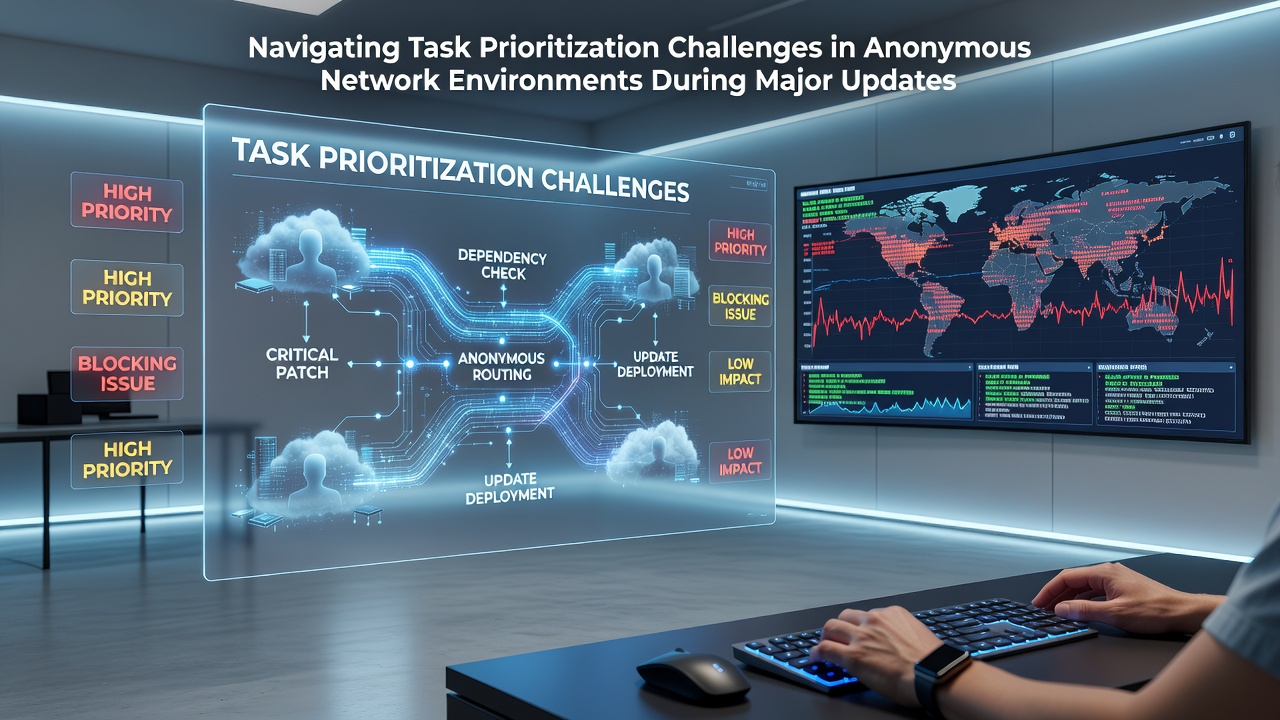
Task prioritization in these settings requires sequencing activities like patch deployment, key rotation, and traffic analysis mitigation, while operators weigh factors including relay uptime, consensus participation, and resistance to traffic correlation attacks. Studies from academic groups at institutions including the University of Waterloo indicate that timing windows for updates shrink when network load spikes, forcing administrators to rank security patches above feature enhancements.
Update Cycles and Emerging Pressures in 2026
Major updates scheduled for October 2026 will introduce revised directory protocols and improved congestion control algorithms, according to announcements from core development teams, and these changes coincide with heightened regulatory scrutiny in multiple jurisdictions. The European Union Agency for Cybersecurity has published guidance on secure software maintenance for privacy-preserving systems, while Canada's Centre for Cyber Security released parallel recommendations focused on critical infrastructure resilience.
Observers note that anonymous networks face simultaneous demands during such rollouts: nodes must validate new software binaries through reproducible builds, apply changes without disrupting ongoing circuits, and monitor for emergent vulnerabilities introduced by the update itself. Research published in IEEE Security & Privacy journals highlights that relay operators often allocate limited computational resources first to cryptographic verification tasks, then to performance tuning, because a single compromised binary can expose entire path segments.
Prioritization Frameworks Observed in Practice
Operators commonly adopt weighted scoring models that assign points to tasks based on impact severity, deployment risk, and dependency chains, allowing automated scripts to surface the highest-ranking items for human review. One documented case involved a European relay collective that shifted focus from bandwidth expansion to protocol compliance checks after a directory authority flagged inconsistencies during pre-update testing.
What's interesting is how geographic diversity affects these decisions, because relays in high-latency regions may deprioritize real-time traffic shaping in favor of batch processing to conserve energy and reduce heat signatures that could aid physical identification attempts. Australian research consortia have measured similar patterns, finding that update windows in the Southern Hemisphere often align with lower global traffic volumes, giving operators slightly longer intervals to complete verification steps before peak loads return.
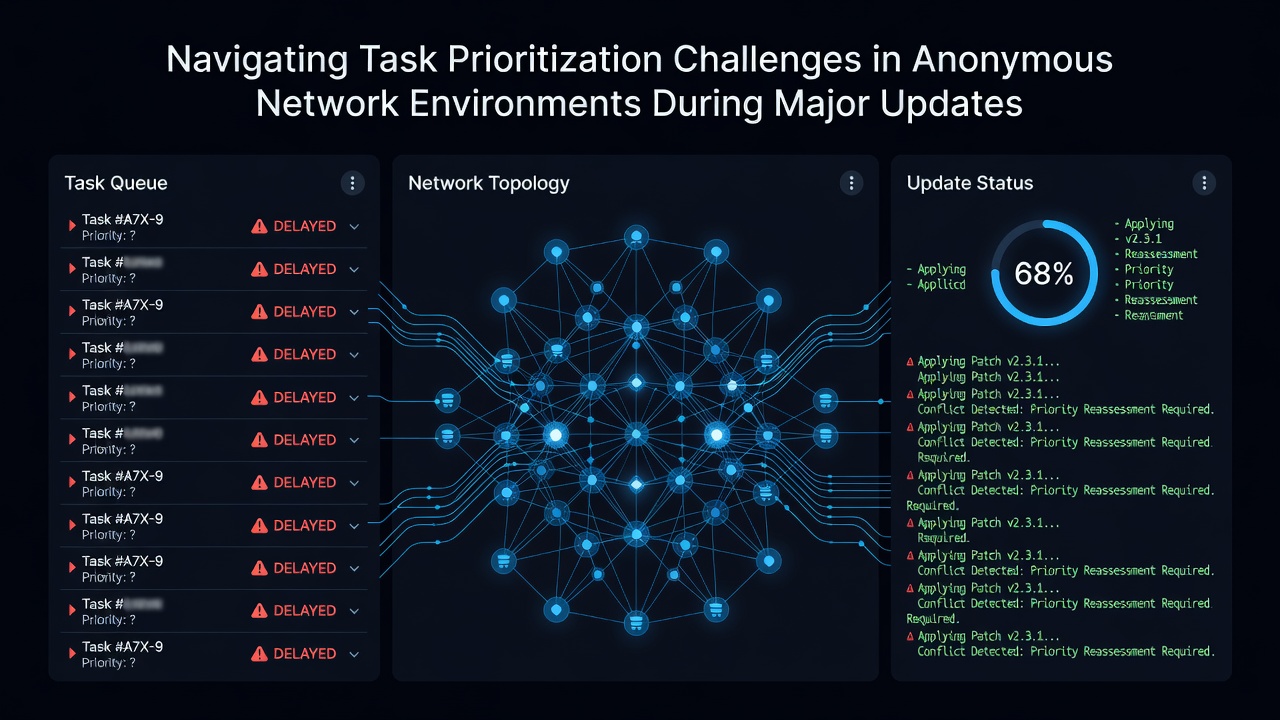
Additional pressures arise from the need to maintain forward secrecy during key exchanges embedded in the update process, and this requirement frequently elevates cryptographic housekeeping above secondary monitoring enhancements. Figures released by the National Institute of Standards and Technology outline baseline procedures for validating update integrity in distributed systems, procedures that anonymous network maintainers adapt by adding extra layers of peer attestation.
Resource Allocation Patterns Across Relay Types
Guard relays, exit relays, and middle relays each face distinct prioritization queues because their roles determine exposure levels and traffic volumes they handle. Exit relay operators, for instance, allocate more cycles to abuse reporting integration and policy compliance checks during updates, whereas guard relays emphasize entry-guard rotation stability and client circuit handshake compatibility. Data aggregated across multiple measurement studies show exit capacity representing roughly 15 percent of total network bandwidth, underscoring why those operators often sequence tasks differently from the larger middle-relay population.
Coordinating these varied queues across thousands of independent operators requires shared tooling that surfaces consensus-critical tasks first, followed by performance-related patches. Teams that have implemented such tooling report fewer circuit failures during transition periods, although exact percentages vary with network conditions at rollout time.
Conclusion
Task prioritization within anonymous networks during major updates rests on balancing security verification, operational continuity, and confidentiality preservation, with each relay type applying distinct weighting to available resources. Evidence from standards bodies and academic measurements illustrates how October 2026 cycles will test existing frameworks, yet the same distributed nature that creates challenges also supplies redundancy that operators leverage through careful sequencing. Continued refinement of scoring models and cross-jurisdictional guidance should support stable transitions as network scale and regulatory expectations evolve in parallel.